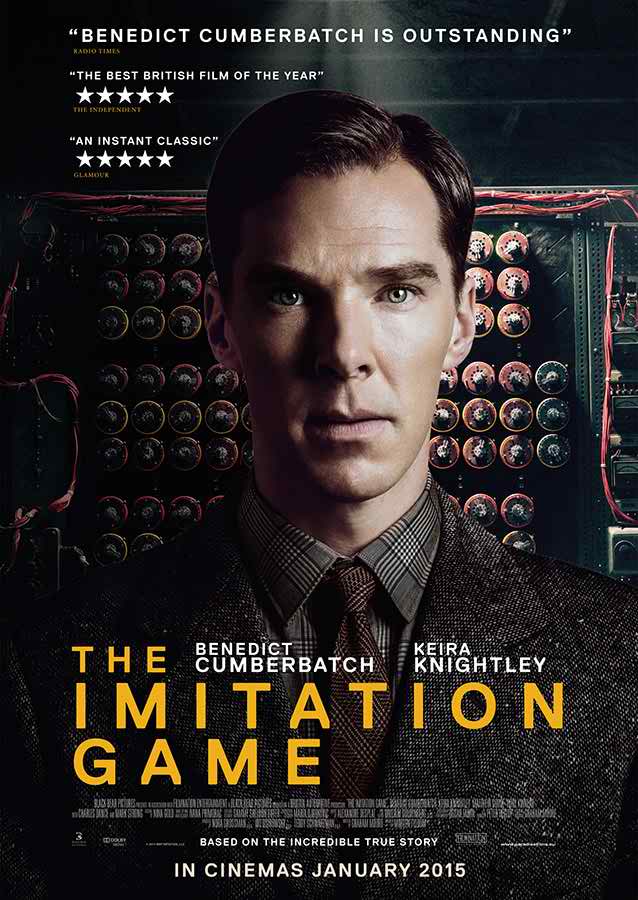
Alan Turing is one of the most important minds in history – a father of invention. He invented a machine that became the modern computer. But why did he do this? Enigma.
Enigma is the name of the Nazi code system and machine for all of their communications during World War 2. An unbreakable code which Turing (Benedict Cumberbatch) sees as the most difficult puzzle in the world, and he likes puzzles. He’s also a genius.
Though we don’t get to see how Turing’s creative process works, Turing decides that since…
‘what if only a machine can beat another machine?’
…he is going to design and build a machine that can break a code which has:
‘150 million million – possible combinations of 10 pairs of 26 letters on the plug board.’
Cumberbatch is believable in his role, there is little depth however, and few interesting ideas for him to grab a hold of and play with. One or two emotional moments could have been effective if well written, but I felt they were without power. Our leads, Cumberbatch and Kiera Knightley as Joan Clarke (possibly the smartest person in the room) have to make difficult moral choices which have tragic consequences – there would be feelings of sympathy and sadness for the people wracked with the pain of loss. Unfortunately these moments aren’t the main story so there is little development to try and get the viewer to feel what the character is going through.
The viewer feels detached from the emotional event. Even the ending doesn’t grip us absolutely – it is the most emotional part of the whole story – mainly because it’s based on a true story and it’s really the epilogue which has the emotional effect – as we discover what ended up happening to Turing after Enigma, after the war. As terrible as it is, this film should dramatise events, the most emotional event in the story should not be just words on a screen.
This is a movie about genius and how we as a species treat outcasts, rebels, creative thinkers. It could just as easily be another Steve Jobs movie. But it’s also about how that feels – how tragic it is to mistreat our greatest. How the school system throttles the free thinker, how society reacts to those of us who don’t fit in. How we kill our greatest hearts and minds. (brings to mind a more effective movie in this way – Kinsey, portrayed by Liam Neeson.) How we manipulate a system to glorify cruel and pathetic cowards and alienate the passionate, compassionate, and strange – who don’t know how to ‘get along’. Perhaps because they have spent all of their brain-spasms on creating, evolving and answering those difficult questions, they have nothing left for what they may deem unimportant – fitting in. Of course they don’t fit; their minds and hearts are too big.
Here I state that this is what the film seems to want to be about. Unfortunately, the story doesn’t tackle much of these ideas and emotions in any depth. A young Turing (Alex Lawther) in school is briefly explored (with fairly positive results) – his homosexual and platonic (paradoxical) relationship with Christopher (Jack Bannon) – whom he names his machine after.
The genius moments are not uniquely or powerfully expressed – that’s what you really need in a movie about a genius – moments of little breakthroughs – a revealing of how this wonderful mind works. (A Beautiful Mind was far more effective at this – it would be up to The Imitation Game to find a new way of achieving a level of power equal to or greater than.) And it would have been nice, had they really explored and effectively expressed how we treat our geniuses and how tragic that is, rather than as they did, throwing it in at the end.
 the joy of eating and the folly of thinking