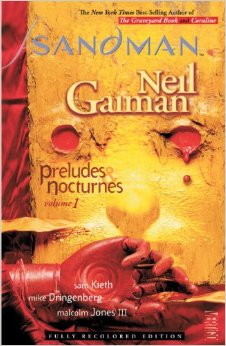
I am new to Neil Gaiman and to the hit graphic novel series The Sandman. Although I am familiar with the character who inspired the series (The Sandman from DC comics’ Justice Society of America – the very first superhuman team, preceding the great and wonderful Justice League of America and written in the same world. In fact some of the JSA characters have stuck around long enough to enjoy small roles in Justice League stories and a few characters like Michael Holt aka the second Mr Terrific and Alan Scott, the first Green Lantern as well as Dr Fate – were gifted with major roles in other DC properties such as Checkmate and Justice League International) and I have wanted to read Gaiman and his Sandman ever since I first learned of his works when he wrote a book called Good Omens (which I didn’t read) with Terry Pratchett.
All of my friends and associates would rave about Gaiman and assured me I would love his work, based on what they already knew about my tastes. I didn’t doubt them, I simply never found myself in a situation where I could read his work. Until now; I paid my fifty cents and borrowed the first volume of The Sandman from my local library. I was excited, despite myself. This was a challenge, this was a new experience, here was a new author, here was a story that most people thought was good and the people who thought so were my kind of people as well.
You want to know if I liked it? Well, I will let you off the hook, I did and then some. But I want to express and explain to you what finally discovering Neil Gaiman’s most famous work was like for me as an experience. There are some books that are incredibly easy to read, entertaining, funny and you consume by the truckload – I would think of Terry Pratchett’s Discworld novels as an example. Other books are thick with a unique kind of language, not so easy to read, but rewarding and massive depth to the stories – Greg Egan’s novels come to mind. Then there are books that you laugh and grin evilly because you know the secret, you’re almost too excited to read, that you readjust yourself and jump in your seat – you have realised that this is a wonderful author who is doing something new and exciting with his stories and you are actually in a love affair with his work. I feel this way about Orson Scott’s Card’s Ender’s Saga and Beyond Ender’s Saga – and I felt this way when I finished reading the first volume of Gaiman’s Sandman – he calls it Preludes and Nocturnes.
This graphic novel is a collection of the first few single issue comic books in the series; it also comes with a forward written by Sandman’s original publisher, Karen Berger. I feel it is essential that violence be innovative. Here, the violence, if not particularly shocking, is inventive, interesting, guided by the story and necessary. The bad guys are intriguing, but not yet scary. I think there is room for improvement – which hopefully happens in the books that follow in this series. According to Berger, this first volume is only the beginning, so I certainly look forward to more.
A group of inept magicians cast an incantation to attempt to summon and bind Death. However, instead they receive our title character, Dream; the sandman. Despite the fact that this was a mistake, they decide their only option is to keep him imprisoned until he agrees to grant them power and promises to not seek revenge. He waits them out. Dream can wait a long time. He is one of the endless; one of the few elite characters in the story of the Universe, who never die; immortals whose responsibility is to curate life. To each keep their tasks in order, to maintain existence as it has always been. Without these immortals there would be no life, only chaos.
Upon trapping dream, the magicians also steal his toys; artefacts which he has filled with some of his power in order to use them as tools in his craft. Because he has used them in this way, the artefacts are magical.
Dream stays imprisoned for a very long time. His captors grow old and die, his toys are stolen, lost, scattered. Eventually we realise that the Sandman is not simply an antagonist, or a voice for the story, but is the central character. And that, people who choose to mess with the structure of reality, effect consequences which are felt by all mankind; that summoning Dream with the ambition to trap Death and earn power is about the most selfish act one could take. Dream is more fearsome than the Grim Reaper, yet he is simply trying to put things back as they should be. The punishment for those involved will be harsh, but deserved. The Sandman’s power is unequalled, but he has been down there a long time, weakened, starving, forced into an absence of action/reaction. It won’t be forever and he is patient.
Dream’s powers are hinted at for a while, eventually we get to see what he can do and this does not disappoint. One of the coolest things about the writing of this story is finally getting to see the Sandman unleash his powers on people; to see how absolute power (but only over dreams) can be used. The Sandman’s most useful skill is in fact his cleverness; his smarts are like those of a chess player. Yes, he is a very powerful character, but sometimes he is weakened, or his power is compromised for one reason or another. It’s due to his intense cleverness that he is able to negotiate the problems he tackles and always come out on top, when he does use his powers (we get to see the innovative ways he can slay or punish) it is the flexibility and ingenuity of his mind that make him so powerful, not simply that he has absolute power over dream (also he is not always at full power; sometimes he is vulnerable.)
The characters are the most dazzling element of this graphic novel. I didn’t expect the Sandman to be such an interesting character; deep, complex, cool yet vulnerable, powerful yet humble. The story is a bit straight forward; mostly concerned with the binding/kidnapping of the Sandman and the effects of that on the world, of when he gets free – punishing his captors and finding his toys. But the way these scenes and sequences are written is fantastic.
One of my favourite scenes is when Dream is forced to visit Hell to reclaim a toy that was gifted by a man to a demon. So Dream has to mind-fight the demon which is a really cool sequence; again some great characters in Hell – the demon, Lucifer, and the rest of the triumvirate. I love to see Dream using the power of dreams in creative ways; one time he punishes the descendant of his captor with ‘eternal waking’; which is when you think you’re awake then you wake up – nightmares within nightmares; in my opinion his creative choice of punishment is probably one of the worst punishments anyone could have dealt.
A central character to the sequence about cleaning up the mess that formed in Dream’s absence, started out as a comic book villain in the DC world, but is recreated here as a horror villain. He is really interesting. His origin story and the scene where he escapes Arkham Asylum are really cool, but the peak of his storyline is probably when he manipulates a scene like something out of Stephen King, where regulars in a café begin behaving like morally bankrupt lost souls and sex, violence and death ensues.
Overall, I think the writing is excellent, very imaginative and original but also thorough and clever. I think the story is good as a setup, though not the most original concept or structure. I think the art is very effective in creating the tone to match Gaiman’s story, but not mind-blowingly artful. I think the characters are the strongest element in this book – and the cleverness, or otherwise effectiveness of these characters is due to great writing. This book is highly re-readable and I’m very excited about reading more of this series.
 the joy of eating and the folly of thinking