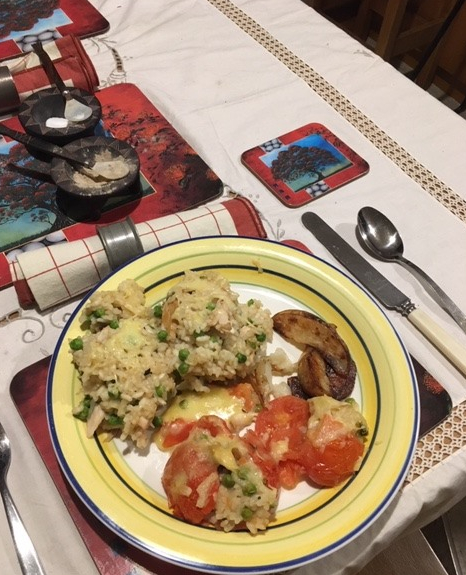
Recipe: Yemista (greek stuffed tomatoes/red peppers) with wedges on the side and semmel knodel (bread dumplings)

3-3.5hrs to cook + prep time:

ingredients

(yemista)

5 large tomatoes/peppers – red

5tsp olive oil

3-4 potatoes (optional)

193mls uncooked arborio rice

1 large onion (chopped fine)

3 tsp garlic

1 tsp salt

1/2 tsp pepper

5 cups water

1 tbsp tomato paste

1 tsp sugar

Lots of edam and some parmesan

(semmel knodel)

300g bread

1 cup milk

1 medium onion (minced)

2 cloves garlic (minced)

5-6 shiitake mushrooms (chopped fine)

2 tbsp parsley (chopped)

1 egg

salt and pepper to taste

Method

  1. Prepare all veges
  2. Peel and finely chop the onion and garlic. Finely grate the Parmesan.
  3. Heat a frying pan.
  4. Boil the jug of water.
  5. Put in a large metal bowl 2-3 oxo cubes.
  6. Grind the oxo cubes.
  7. (optional) add ⅓ wine to the bowl
  8. Add boiling water.
  9. heat the oil and 1 small knob of butter over a low heat, add the onions, garlic and celery, and fry gently
  10. Turn up the heat, When spitting, season the rice with herbs
  11. Then add the rice and sauté for 1min
  12. add 1 cup (five total cups) of broth.
  13. Turn the heat down to medium, Stir the rice until all gravy is absorbed.
  14. Repeat until you’ve added 3 cups. (after 2 add some cheese)
  15. Add shredded chicken, more cheese, peas and mushrooms.
  16. Stir in another cup.
  17. Then again for the last cup.
  18. Taste the rice. it should be sticky and soft, but not slimy or chewy.
  19. If not soft enough, cook for a further 5mins
  1. Cut off tops of tomatoes (retain tops) and carefully scoop out flesh (retain this as well)
  2. Place tomatoes in a casserole dish or tin large enough to hold them comfortably and give each veg a tiny dash of sugar with the tips of your fingertips.
  3. Add olive oil, risotto, onion, garlic, cheese, 1 teaspoon of salt and 1/2 teaspoon of pepper (or season to taste).
  4. Stuff the vegetables evenly with this mixture.
  5. Replace tops of tomatoes and peppers.
  6. Combine 1 cup of water and 5tsp olive oil with a scant tablespoonful of tomato paste and a little salt and pepper and pour this around the veg.
  7. Also take 3-4 medium-sized potatoes, cut them into big wedges, toss in a little olive oil with salt and pepper to taste, and ‘plant’ in the spaces amidst the stuffed tomatoes.
  8. Bake in a preheated (15mins @ 180C) oven for approx 45mins-1 hour (tomatoes should pierce easily and be slightly blackened in parts).
  9. Turn off oven and leave in for another hour to ‘mellow’ before serving.
  10. Add the rest of the risotto to the dish surrounding the tomatoes/peppers.
  11. This is best served slightly warm or at room temperature.

Semmel knodel – german bread dumplings

Method continued

  1. Roughly break the bread into a large bowl. Bring the milk to a boil and pour over the bread. Cover and let it soak for 2 hours.
  2. Heat some olive oil in a pan and cook the onions until soft and lightly browned. Add the garlic and after a couple of minutes, the mushrooms. Cook until the moisture that escapes from the mushrooms evaporates, about 5 minutes. Season with salt and pepper.
  3. Add the onion and mushroom mixture and the chopped parsley to the bread. Mix well to form a dough – the dough should be soft and moist but firm enough to form balls. If it’s too dry, add more milk. If it’s too wet, add some breadcrumbs, plain flour or semolina.
  4. Wet your hands and roll the dough into balls, slightly bigger than a golf ball.
  5. Put a pot of salted water to boil. Once the water comes to a rolling boil, reduce the heat so it simmers. Add the balls into the water with a slotted spoon and cook for 15-20 minutes or until they bob to the surface. Remove and drain.
  6. Serve the Yemista and wedges with dumplings on the side.
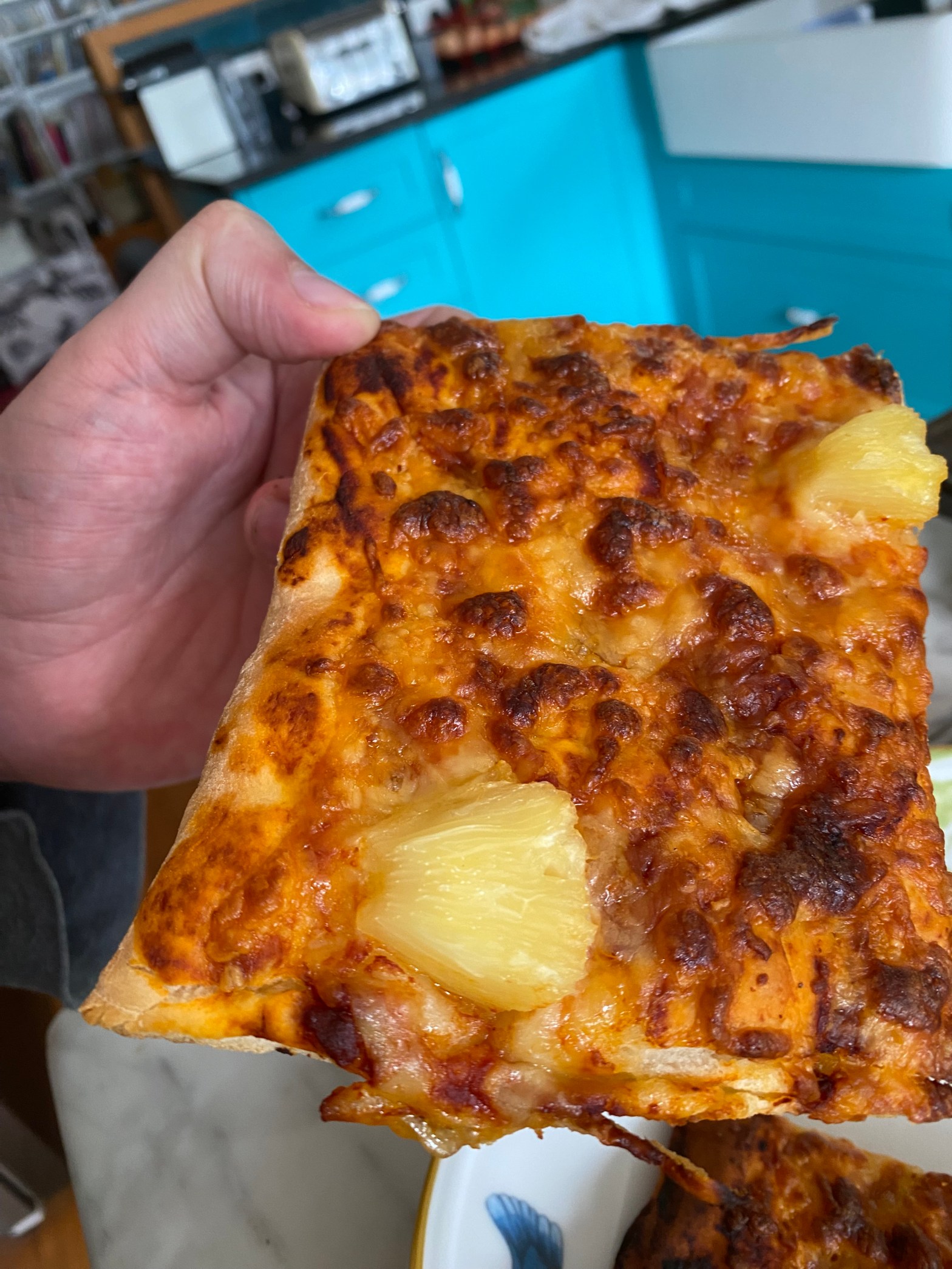
how to make really tasty pizza dough for the everyman

Ingredients

sugar: 1 tbsp

hot water (not boiling or you’ll burn the yeast) 1 1/3 cup

yeast 2 1/4 tsp

3.5 cups of all-purpose flour

1tsp salt

2tsp oil

method

  1. Activate yeast:
    • Get your mixer (like a Kenwood mixer with dough hook) bowl.
    • Pour in 1tbsp of sugar.
    • Add 1/3 cup of hot water.
    • Mix it together until the sugar dissolves.
    • Sprinkle the 2 1/4 tsp of yeast on top and then mix a bit with a wooden spoon.
    • Cover with a tea towel and leave somewhere warm for 15mins.
  2. After you come back to it, if it’s not a big frothy mixture it didn’t work.
  3. Add 3 cups of flour.
  4. Add 1tsp of salt and 1tsp of oil.
  5. Beat in mixer on level 2 or low level for 2 mins with your dough hook and add the last 1 cup of hot water gradually.
  6. You shouldn’t need more flour, but you can add 1/2 cup if it’s too sticky.
  7. Turn up to med high or 8, or knead by hand, for 5 mins.
  8. Take it out and put your last tsp of oil in the bowl, then wipe it around with a brush.
  9. Put the dough in the bowl and cover with a tea towel again and leave somewhere warm, to rise for 45mins.
  10. Preheat oven to 246 degrees C for 15mins while dough is left to further rise.
  11. The dough should rise, it will be obvious that it’s puffed up and light looking.
  12. When oven is preheated after the 15mins, punch the dough softly and leave for another 5mins.
  13. Put the dough in a greaseproof tin or two and spread it out, letting it hang from your fingers in the thick parts can help stretch it, (you can throw it around, but don’t drop it on the floor) fill any holes with fatter bits.
  14. Stretch the dough into the tin/s.
  15. Spread on tom paste and ingredients – cheese, meat, pineapple, sundried tomato, oregano etc.
  16. When it’s nearly dinner time, cook for 10mins.

JS program 3 – more complicated than 2 (it does some calculations, that’s all)

the minus calculation doesn’t work because I haven’t learned how to do negative numbers yet. or loops. that’s next.

<!DOCTYPE html>
<html>
<body>

<h2>second game</h2>

<script>
var num1 = 0
var num2 = 0
var numplus = 0
var numMinus = 0
var numTimes = 0
var numDiv = 0

num1 = prompt ("Can you please give me a number?");
num2 = prompt ("How about a second number?");

num1 = eval(num1);
num2 = eval(num2);
num = num1 + num2;
numplus = num1 - num2;
numTimes = num1 * num2;
numDiv = num1 / num2;

alert ("the total of your two numbers is " + num);
alert ("number 1 minus number 2 is " + numMinus);
alert ("number 1 multiplied by number 2 is " + numTimes);
alert ("number 1 divided by number 2 is " + numDiv);
</script>
</body>
</html> 

Super meat boy: level one

I got through the main stages of level 1 – forest, quite easily. Once I got to the boss stage, I found frustration. I gave up for a while. Recently I had another hardcore attempt at beating it. I succeeded but it took me two hours. I found that while earlier I had thought that there is only one solution to each problem. That is, in fact, not the case. There is a swinging saw x 3 construct where you wait for the right time and then you run back and forth, then full on through them, without dying. But in fact you can combine the right time with jumping over the last saw and if you do it this way then you don’t have to be quite so precise about the timing.

I found that there are some tricky bits toward the end of the stage that are not so difficult, it’s just that you have only a second to decide how to approach them and because they are so far towards the end of the stage, you will have experienced these problems very little. Whereas the earlier problems will be by now like second nature. Except that fatigue sets in and you keep making stupid mistakes, which gets you killed repeatedly at the early, easy obstacles.

I find Ed McMillen’s design to be deliciously precise and particular, which may seem a bit formulaic at first, but I think it’s more that he pays attention to structure with this game. It’s not less artful. And I think structure and style, with substance, can make a game like this shine. There is quite obviously attention paid to style – and it’s unique. The substance comes through in the modern approach, the older target audience and the precision and difficulty level of the game’s many and interesting obstacles. Most stylish in this game are the character design, the quirky gore aspect, and the fun, slightly edgy graphics (not quite as edgy as some of McMillen’s earlier works, or even as what came later – The Binding of Isaac.)

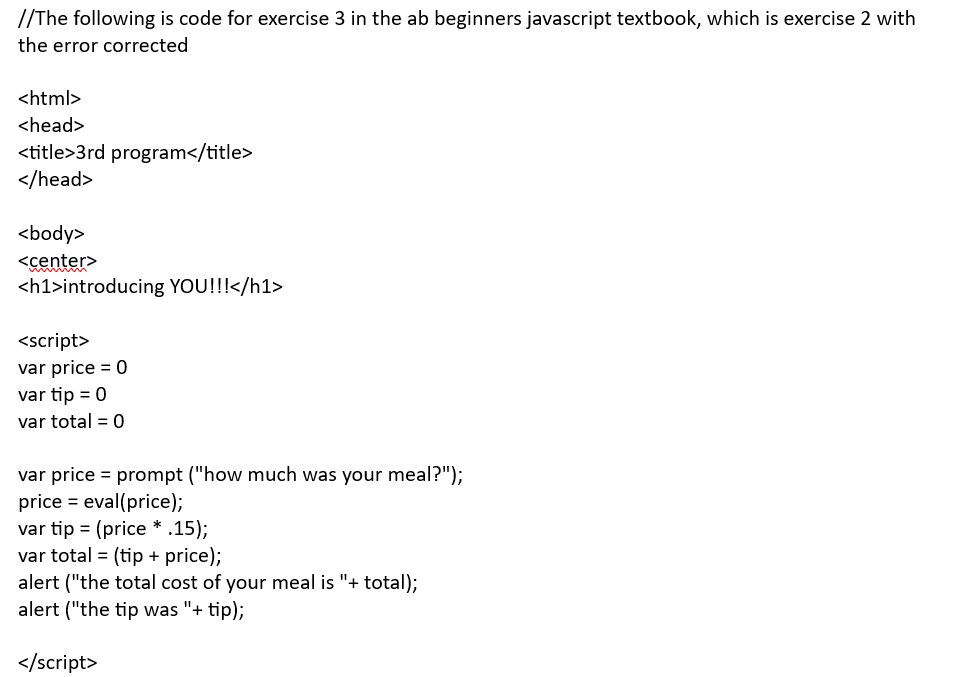
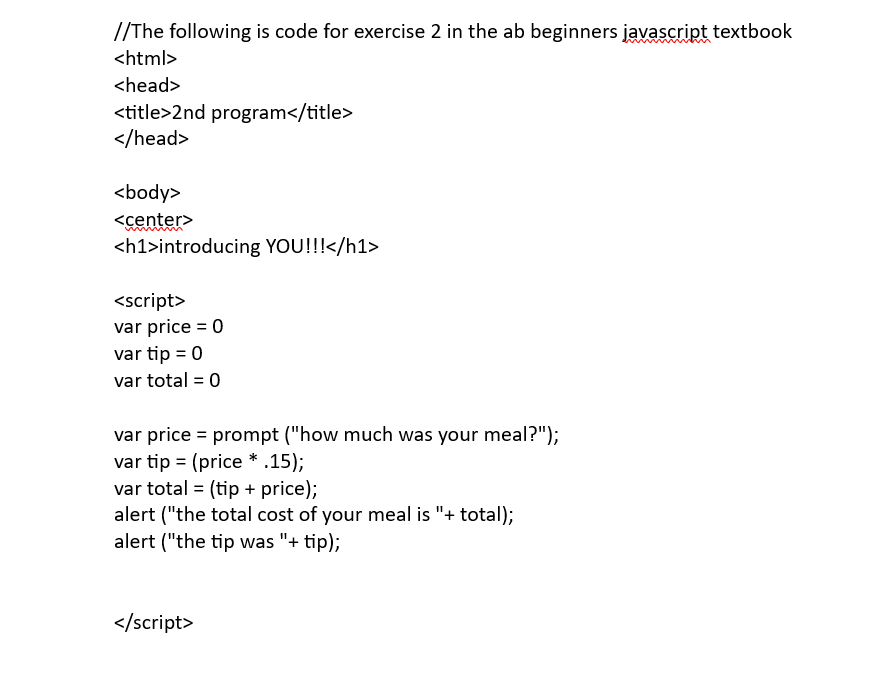
my second program in JS

There is a flaw in the program. But that is on purpose. The book created a flaw so you can learn to see errors. This error is that there is a concatentation done by the computer, treating the numbers as strings and adding them instead of adding the tip to the meal price as a calculation.

The next exercise corrects this error. As we learn how to assess types of variables in Javascript.

Total Car Price (#3 in Python)

carPrice = input (“what is the base price of the car?”)

tax = int (carPrice) * .125
insurance = 250
totalcarPrice = int (carPrice) + int (insurance) + int (tax)

print (“total cost of your car including: insurance $”,insurance,”,”)
print (“and tax: $”,tax,” comes to $”,totalcarPrice)
input ()

This is a program that figures out all your extra costs, when buying a car.

The only mistake I still need to figure out, is what the escape clause is for avoiding having a space at the end of a statement inside a print function.

It works fine, the user enters the base cost for the car.

Program calculates the tax and adds a previously decided insurance cost.

Then the program provides the user with both the individual costs, and the total all-inclusive price of the car.

EDIT:
After some research not in-book, it turns out that you can avoid the white spaces in between statements by using the function sep = “”, which should be treated as a variable – so not inside the quotation marks of the print function, rather, naked inside the brackets.

So the final program now looks like this:

carPrice = input (“what is the base price of the car?”)

tax = int (carPrice) * .125
insurance = 250
totalcarPrice = int (carPrice) + int (insurance) + int (tax)

print (“total cost of your car including: insurance $”,insurance,”,”, sep = “”)
print (“and tax: $”,tax,” comes to $”,totalcarPrice, sep = “”)

input ()

my 2nd program in Python

tip15 = 0
tip20 = 0
price = input (“how much did your meal cost?”)
tip15 = int (price) * .15
tip20 = int (price) * .2
print (“A 20% tip would be “,tip20,” and a 15% tip would be”,tip15)
input ()

I wrote a tipper program for an exercise.
It’s a simple program and it took 20mins to write including several bug fixes,
where I had to go back to looking through the textbook and a few glances at my first program,
before I got it running properly. I made the usual noob mistakes – since I’ve tackled many different languages, I had to figure out if I needed to declare variables.
I also got the variable on the wrong side of the equals sign, then I forgot to include commas in my print statement for the variables. I also forgot to state that the variable was an integer. Finally, I forgot to use brackets and then incorrectly included the calculation inside the brackets.
Eventually, I figured all of this out and came up with the above seemingly simple program.
And it works!

I’m still not using comments, but I’ll fix that when I start writing longer programs.

Design a site like this with WordPress.com
Get started