CREWING FOR MOVIES 4 – BACKGROUND

1986-1999

The concept behind The Thing Under the Bed (1986) was that there was a monster under the bed and he wanted to consume the living. I was four. I was also the writer, director and director of photography for this, my first short movie. I also played the monster. This was the beginning of a tradition of micro budget movie-making improv especially in the horror genre, for my work. There was no script for my first short.

My attitude to filmmaking was simply a fascination and incorruptible, unswerving, immovable desire to tell stories. I picked up the camera – to which the depth of my knowledge was simply pick it up and point it at the thing and press the button. I told people what to do, which I liked. Later I would get cumulatively frustrated by people not doing what they’re told. I eventually decided that if people were paid, they would be obligated to do what I say – therefore I planned the ways that were available to me, to raise the eleven thousand dollars to make my first professional grade short movie.
I would get a job, finish my novel and hope to sell it, and leverage my old web design paid gigs into a computer game programming job via learning Python from books. Somehow I would earn and save that money and I would make my movie.
In high school (having dropped out for a year at the beginning of NCEA 2, this was my second attempt at sixth form/NCEA 2) when I was making my first student short movie – the epic horror parody entitled The Giant Satanic Potato and the Killer Apes from Hell (1999)– it has changed titles many times. These days I just refer to it as Demo Reel 1. There was a scene where a white trash stalker/rapist creeps outside the house of a young blonde teen. He is supposed to masturbate while watching her through the window. With a spark of inspiration, I filled a water bottle with milk, so that the actor could cum on the wall at the moment of climax. Unfortunately, it was a white wall, so the effect was not as it could have been.I later wrote a (so far unpublished) book about my micro-budget and guerilla movie-making experiences.
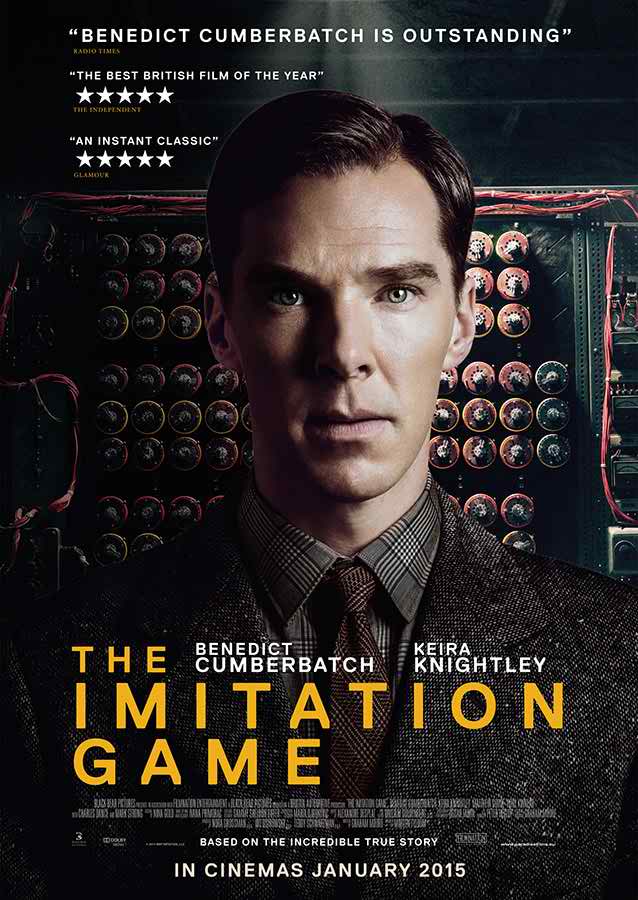
THE IMITATION GAME

Alan Turing is one of the most important minds in history – a father of invention. He invented a machine that became the modern computer. But why did he do this? Enigma.
Enigma is the name of the Nazi code system and machine for all of their communications during World War 2. An unbreakable code which Turing (Benedict Cumberbatch) sees as the most difficult puzzle in the world, and he likes puzzles. He’s also a genius.
Though we don’t get to see how Turing’s creative process works, Turing decides that since…

‘what if only a machine can beat another machine?’

…he is going to design and build a machine that can break a code which has:

‘150 million million – possible combinations of 10 pairs of 26 letters on the plug board.’

Cumberbatch is believable in his role, there is little depth however, and few interesting ideas for him to grab a hold of and play with. One or two emotional moments could have been effective if well written, but I felt they were without power. Our leads, Cumberbatch and Kiera Knightley as Joan Clarke (possibly the smartest person in the room) have to make difficult moral choices which have tragic consequences – there would be feelings of sympathy and sadness for the people wracked with the pain of loss. Unfortunately these moments aren’t the main story so there is little development to try and get the viewer to feel what the character is going through.
The viewer feels detached from the emotional event. Even the ending doesn’t grip us absolutely – it is the most emotional part of the whole story – mainly because it’s based on a true story and it’s really the epilogue which has the emotional effect – as we discover what ended up happening to Turing after Enigma, after the war. As terrible as it is, this film should dramatise events, the most emotional event in the story should not be just words on a screen.
This is a movie about genius and how we as a species treat outcasts, rebels, creative thinkers. It could just as easily be another Steve Jobs movie. But it’s also about how that feels – how tragic it is to mistreat our greatest. How the school system throttles the free thinker, how society reacts to those of us who don’t fit in. How we kill our greatest hearts and minds. (brings to mind a more effective movie in this way – Kinsey, portrayed by Liam Neeson.) How we manipulate a system to glorify cruel and pathetic cowards and alienate the passionate, compassionate, and strange – who don’t know how to ‘get along’. Perhaps because they have spent all of their brain-spasms on creating, evolving and answering those difficult questions, they have nothing left for what they may deem unimportant – fitting in. Of course they don’t fit; their minds and hearts are too big.
Here I state that this is what the film seems to want to be about. Unfortunately, the story doesn’t tackle much of these ideas and emotions in any depth. A young Turing (Alex Lawther) in school is briefly explored (with fairly positive results) – his homosexual and platonic (paradoxical) relationship with Christopher (Jack Bannon) – whom he names his machine after.
The genius moments are not uniquely or powerfully expressed – that’s what you really need in a movie about a genius – moments of little breakthroughs – a revealing of how this wonderful mind works. (A Beautiful Mind was far more effective at this – it would be up to The Imitation Game to find a new way of achieving a level of power equal to or greater than.) And it would have been nice, had they really explored and effectively expressed how we treat our geniuses and how tragic that is, rather than as they did, throwing it in at the end.

HAWKING (2004)

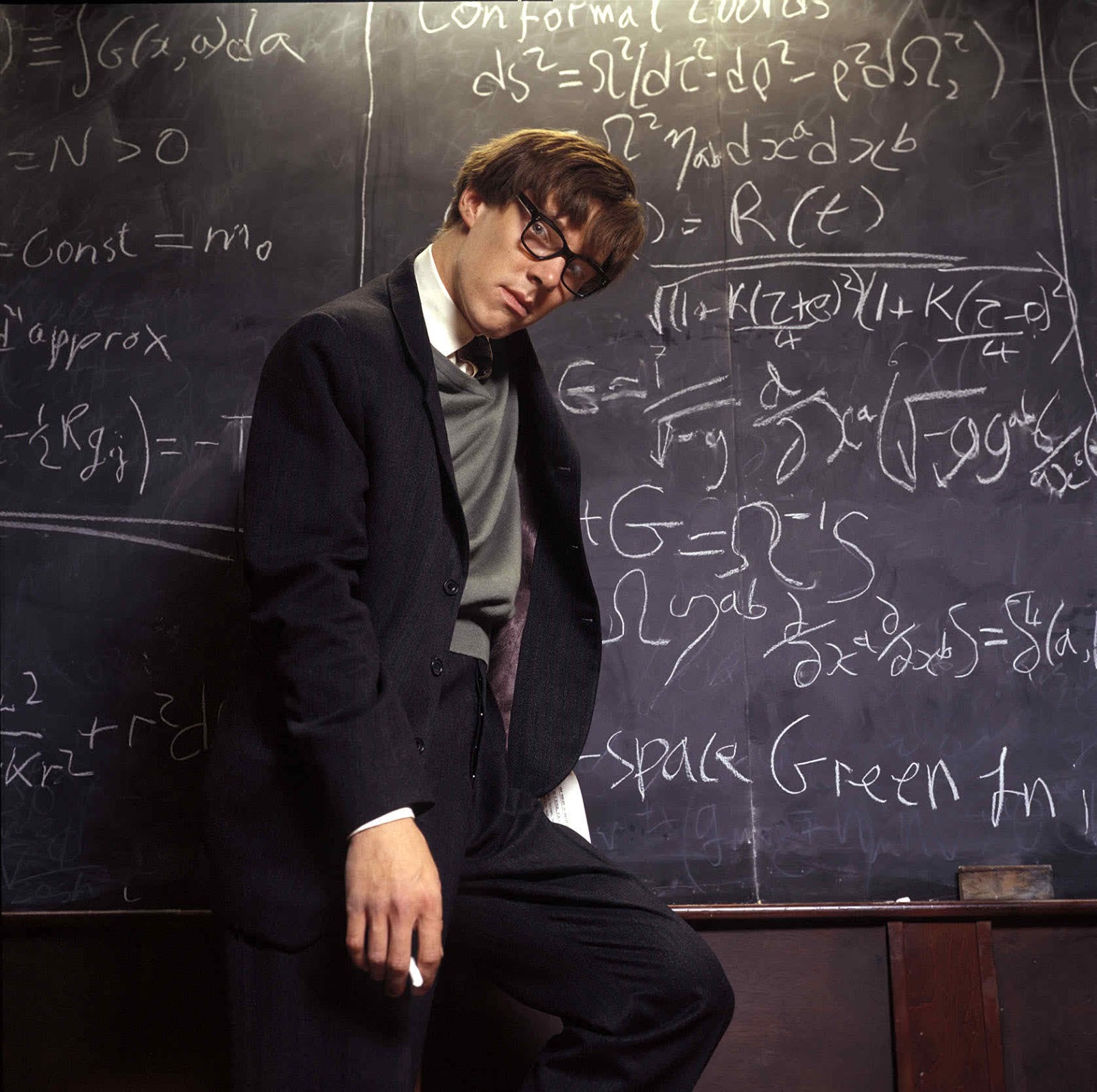
Benedict Cumberbatch portrays a bright kid with a passion for knowledge, mown down by a degenerative disease. We begin with two scientists who are about to accept an award for a discovery. The Nobel Prize.
Stephen endures the science of what we now believe. Which he is destined to shatter with his own discovery.
In the beginning, what we now believe is:

‘There was no beginning of the Universe. Nothing changes. Nothing will ever change.’

In a stylish TV movie version of simulating a behind the scenes interview, two scientists who have discovered something groundbreaking are juxtaposed with Stephen Hawking watching television. On his TV, another scientist expresses a very confident, arrogant, narrow theory about the Universe.
Stephen’s father (Adam Godley) and Stephen’s girlfriend, (Lisa Dillon) have different ways to show their love for him. But his loved ones are loyal and determined to help him live his life, despite his terrible ailment.
The film feels a bit like those British movies about rock stars, but without the drugs and sex.
Roger Penrose (Tom Ward) is a fascinating brain, a friend to Hawking. As if a mind like that can find equals to socialise with. Cumberbatch shows the brilliant mind of Hawking as an incredibly likeable, kind soul. With passion for science, and the pursuit of understanding. He so easily finds wonderful people to celebrate with – even the difficulties of life.
They vastly enjoy aggressive debate, turning over huge concepts and new ways of looking at the world. At first, Hawking applies his mind to testing the ideas of others. The results embarrass one of his Professors. However, his mentor steers him toward original thought.
Penrose is working on a new way of expressing scientific deduction and analysis. It’s faster than calculations. Which is relevant to Hawking because he doesn’t know how much time he has left.
Lots of time is spent studying Hawking’s struggles with both his illness and finding a topic for his thesis.
This is a charming little film fit for television. Both tragic and inspiring. Benedict Cumberbatch shows great range as he wields the role – a difficult character, Stephen Hawking. A brilliant mind. One of the great painful truths is that someone so wonderfully charming is on his way to losing the ability to charm. But not to reason, to scientifically speculate. And to change the world.

THE FIFTH ESTATE

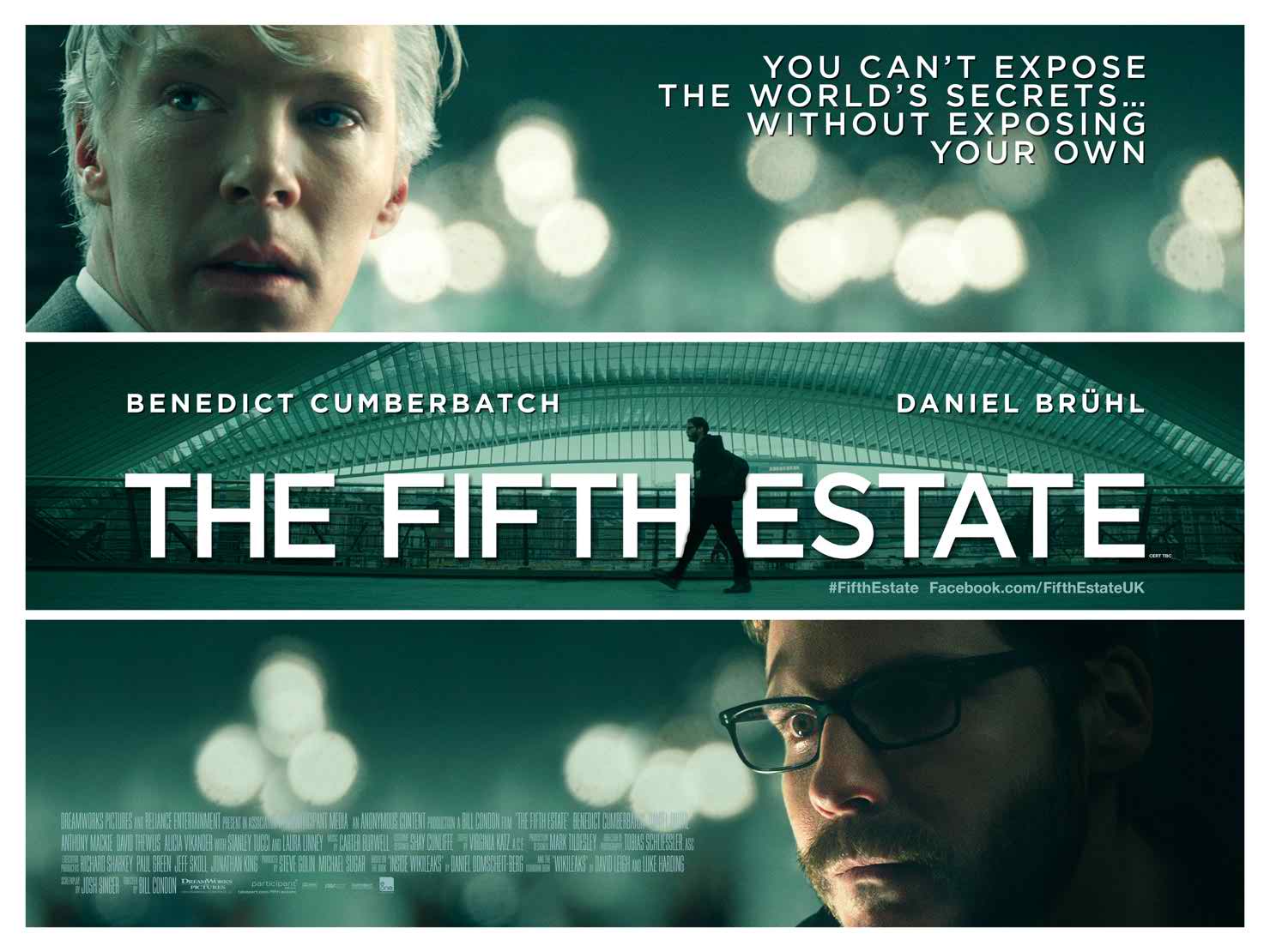
Telling the main story in flashbacks has failed consistently in its effectiveness in contemporary films. We have seen this in the weaknesses of The Social Network and The Iron Lady and in most biopics. They have won awards from antiquated institutions by using stale stylistic flourishes, ways of making that have worked in the past. This results in an artificial and over-used feeling, with echoes of the Hollywood manufacturing machine. However, The Fifth Estate sets a tone with this technique – and succeeds in two ways. First they use it carefully, and with reason. Secondly, they start us off with an ending which we are not meant to fully comprehend… yet.
They don’t just use a flashback for lack of a better technique; they use the flashback, a distortion in time – to distort the viewer, to keep us off guard, while they begin at the beginning. It seems almost to be homage to spy films – thematic because WikiLeaks (the subject of this story) is anti-conspiracy, anti-secrets, anti-spy. The purist anarchist.
And then the story begins to build context and character. We see characters that are complex and intriguing. Nick Davies (David Thewlis) of The Guardian – an English guy with passion and intellect. And Daniel Berg/Schmitt (Daniel Brühl) – the cool, bearded programmer who is stuck in an office job which he is overqualified for. Breezing through life without challenges.
Until he meets at a technology convention a guy who he has been communicating with via chatroom, a Julian Assange. Benedict Cumberbatch transforms himself into an abrasive twerp, yet seen under a different lens, a friendly, altruistic techno-genius. And the creator of WikiLeaks. The mad prophet is also a selfish asshole.
A stew pot of friendship brims with conflict for our quirky, stubborn, activist company founder, Julian and Daniel, the young voice of reason – with his incredibly supportive girlfriend – Anke (Alicia Vikander.)
The pieces are set in place, and then the play begins between our heroes, and the ancient newspapers that refuse to die. And between our heroes and the government. The woman, Sarah Shaw (Laura Linney) who (playing the role calmly and without any real commitment) fights for the government’s protection and the safety of her spies.
Anthony Mackie and Stanley Tucci round out the government bit players debating for the crushing of democracy with one swift boot.
The tragedy of the story is not the relationships and inevitable breakup of the key players at WikiLeaks. The real tragedy is the fact that through all the ground-breaking leaks that are supposed to change the world, our lives continue as if nothing happened. The world continues to turn, as corrupt and unjust as it was before. That transparency solves not the problem of gigantic institutions with power, such as governments and corporations.
The question is raised of the nobility and justification of the revolution and those with unswerving faith. But these are America’s fears. The film digs into some interesting topics and forces us to think, but never breaks beyond thoughtful.

Earth X – the first installment in a series about the history of theMarvel Universe and a possible end to it

Uatu is the Watcher, he has become blind so he recruits a new watcher. X-51 is an android who thinks he is a man. He was a hero for a time, operating under the name, Machine Man.
The problem that mankind faces today is that due to unknown factors, the entire populace has mutated. Everybody is a metahuman; a super – villain or hero, yet to be defined. And now the superheroes of old are being made redundant. These heroes we remember are starting to age, many not so gracefully. Nobody else on the planet is aging, there are few young people and nobody can procreate.
Uatu’s continued frustration stems from X-51’s empathy with, and sympathy for mankind, especially as we get closer to the end of the world. Man is not important. Mankind’s purpose is to act as good bacteria protecting the planet and the host that grows inside it – a child Celestial, by following the Celestial plan which is encoded in our DNA. Everything we do is part of the Celestial plan.
Wolverine is old, fat and lazy. Spiderman is getting pudgy, keeps getting approached by Cage to join the police force and his daughter is Venom. Captain America is the hero of the story, if a story of this kind can have heroes. He is old and slow and beginning to forget what America means, and losing hope in people. He is the last of the heroes and he’s very close to throwing in the towel.
X-51 watches all this happen from the moon, but Uatu first shows him the beginning; the birth of mankind, the visit of the Celestials and others, and the creation of the moon as an eye in the sky – to watch over Earth. It is Uatu’s goal to show X-51 what the Celestial plan is.
Reed Richards, after the death of the invisible girl and her brother Bobby – the human torch, by Namor: the Submariner, has donned Dr Doom’s old costume and lives in Doom’s castle. Him and Tony Stark are trying to undo the absolute mutation which Reed thinks he caused, they are pooling their minds and resources to stop the end of the world.
What I like most about this book is its scale – epic would be an understatement. A powerful God story is what they’ve achieved here through Jim Krueger’s writing, supported and matched by awesome sketches and materialised in those expected and hoped for images. This is a story of time about the birth of the Gods themselves and one very thorough concept of what it means to be human. Why are we here? Many books ask this question. This one hopes to provide an answer, beyond Uatu’s stale loathing for the very human habit of clinging to the concept of good and evil. There is no good, nor evil he states (though those that do state it, are usually the evil ones, so it’s a bit of a cop out.) There is only the Celestial plan.
In fact there is a mirroring of real life here. We are so insignificant in the world and therefore our lives are insignificant on the scale of the universe, so what does it matter what a man’s deeds are? It’s an argument that succeeds if its attempt is to draw out thought and feeling from the reader.
The story dares to go deep and explore all interesting tangents and relevant inquiry. At the same time we are introduced to some lesser known and our main Marvel staples. We get to know these characters, even if Uatu believes their lives to be insignificant. I must warn dear reader, here. Uatu’s distance is not without reason. The story of man is part of this birth and death of heroes and the story of mankind is truly depressing, even X-51 has trouble accepting the whole of it. But the story balances out towards the end, if not less depressing then at least somewhat satisfying. Like a very big meal. You might not be sure you want more, but it’s pleasurable to know that there is more when you are ready.

BIG KAHUNA


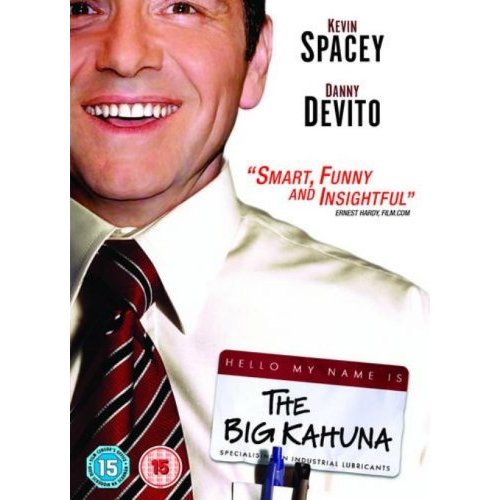
Understated. This film is a minimalist – almost a video stage play about travelling salesmen, set at a convention. It’s about what you can tell about someone from a handshake. What you can learn about each other – three men sitting in a hotel room for a day. Phil (Danny DeVito) as the kind and generous mentor to the younger, complex, tightly wound and not everything he seems to be, Bob (Peter Facinelli).
Larry (Kevin Spacey) is the more abrasive, yet playful motivator. It’s more than merely philosophy, it’s drama. Bob seems naïve, but also judgemental and arrogant. These are complex characters and their tolerance of each other is continually tested.
The opening is artful. The story is a play. The dialogue flits from topic to topic, testing each other out with tense verbal attacks. The film relies on these taut performances. The writing is subtle in concept, yet powerful in conflict. The ideas are about how we live our lives, how we carry ourselves and present ourselves to others. How we lie to each other and to ourselves.
The story is simply three guys talking about sales in a hotel room. It could be more, but it isn’t. However, the way it is written and performed grabs the viewer’s interest and keeps you watching as these characters spar with each other while at the same time walking on eggshells around the elephant in the room.
Bob is the catalyst for the two distinguished and noble players to bounce around dramatic dialogue.

THE BIG SHORT (2015)

This film, together with Margin Call (2011) are the best depiction available of the subject matter; the real estate crash of (2007-2012) and the shudder of the world’s economy. One of the coolest things about this film is the way it is truly accessible for people with all kinds of backgrounds, especially considering the complexity of the content that is being explored.
This is not a comedy. Rather, it is a quirky, true story about a few heroes, a giant system of frauds and stupid, greedy people. And it’s about the tricky subject of economics – in the same way that Money Ball (2011) is about mathematics.
The performances are brilliant. There are so many interesting and complex characters.
“But you’re happy, when you’re unhappy.”
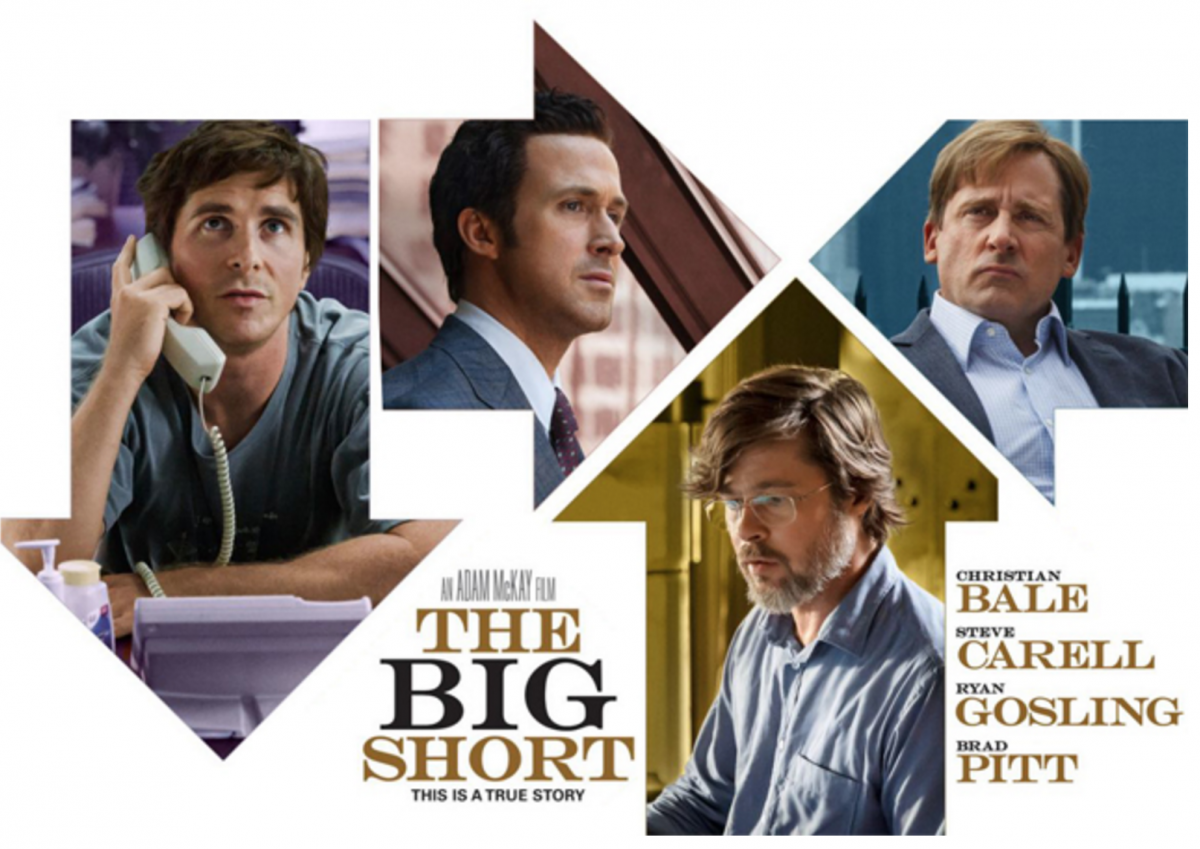
Steve Carell lets his role consume him as he plays Mark Baum – an abrasive, angry and tired twit; the lovable, Anti-Corruption, dragon slayer, who recently lost someone close to him. He is also really good at his job, even though it is driving him crazy.
Meanwhile, Christian Bale gives us a powerful and effective portrayal of a Pantera/Metallica-loving drummer/fund managing business owner – a brutally honest and socially awkward Professor – the guy who discovers the real estate bubble at the start of the movie.
Two kids trying to make enough money to sit at the big boys’ table (and who started with only a few thousand.) Brad Pitt’s crazy vegan farmer, Ben Rickert – an ex-trader savant, who met one of the kids while walking their dogs together.
And the narrator Ryan Gosling’s Jared Vennett – who is the connection between Professor Mike and dragon slayer (Carell). He brokers the deal that gets things going.
One of the very cool things about this movie is its immensely effective structure – you’ve got a number of protagonists with overlapping and interrelated storylines, which are connected in very complex ways. However, the way it’s structured, makes this complex weaving of stories entirely accessible.
Also some of the complicated concepts about economics are humourously simplified and expressed in interesting and glam ways – such as Margot Robbie in a bubble bath and Anthony Bourdain’s fish metaphor. It’s supposed to be ironic, because the real estate crash was partly due to greedy stupid people committing mass fraud by hiding the fact that worthless bonds were being sold as premium quality – and making the subject so complicated that nobody can understand it, which is how they got away with it. But it also simplifies some of the more complicated aspects of the economic concepts that are important to the story – which makes the film accessible to a wider audience than would otherwise be able to follow it.
The story lacks drama because none of the characters struggle with conflict. Everybody wins. Yes, for the most part of the film, many of our heroes are fighting an uphill battle. We hope they will win and when they do it is satisfying. But there is no real internal, interpersonal or external fight. Rather, the fighting happens before the story begins and the winning happens at the end. It feels like we only see the point at which they all collide and when the major event of the actual crash happens. But we see very few victims. And we never get to see any of the heroes deal with real conflict. Despite some great structural and dramatic writing, much of the potentially dramatic situations are expositional through explanatory narrative dialogue. All of this potential is wasted because you get a really good movie about how these lives affect each other – but you don’t get an epic drama, which it could have been. This was a conscious decision of what to write and what not to write. Something dramatic could have vastly elevated this film – is the only weakness I found.

THE COLLECTION (2012)

Polished B-horror of a serial killer nature, but not much fun. Stock standard build-up and introduction of genre-typical characters. The innocent, self-effacing loser who is in love with the reluctant gentle heroine, Elena (Emma Fitzpatrick) whose best friend is the slut. The asshole ex-boyfriend, and we all know what happens to the despicable character.
Looking for a party and they find a rave. Nice design of the monster’s weapon, however. The rigged building as death machine is cool. Not as interesting as the machines in Saw. The deviant art in The Cell is more visually interesting than the Masked One’s art collection.
Low-level violence – a few bloody corpses, lots of splatter.
READ SPOILER

A gross face-crushing moment delivers some gore, but it’s only just seen, before the gentle heroine is collected. The tortured thief, Arkin (Josh Stewart) escapes cleverly, yet predictably.
In the hospital, it gets a little spooky. Lucello (Lee Tergesen – the bullying older brother from the ‘90s TV version of Weird Science) leads a team of assassins to hunt the monster, using Arkin as bait.
This young girl’s fears are not traumatic, yet she is forced to witness torture and murder. The height of her panic is short, sharp breaths. She is smart enough to figure out how to escape the trunk, but the monster expects her to.
The real fun is in watching Arkin help the assassins in their hunt. The writing of this story is weak, though the production is fine and the acting is regal. All of the assholes will die, that’s a given.
This triumphant maze is well more intelligently constructed than the dumb story, which is also, for the most part, not scary. The fears are not intellectual, they are blunt instruments.
READ SPOILER

Trickery is inserted in the form of a false innocent.
The surprises are strong, but they follow a predictable path.
Arkin is quick-witted, tough, reasonable, with a powerful survival instinct. He and Elena would make a great team if they had more scenes together, as they are the film’s only interesting characters.
The tension builds, (one hour into the film,) finally it’s getting a little scary. Arkin tries to find a way out, while in another part of the house, Elena hides from the Masked One.
He has a method, his collection is not random. It feels disappointing, all the crazy traps and drugged zombies, with no brilliant scheme tying them all together.
If the story was more intricate, the film could capitalise on a common fear; A building that is so deviously designed and solidly escape-proof, that no matter how many doors you open, you will never get out.
READ SPOILER

There is a very nice scene where Arkin breaks his arm on purpose, to escape a trap.
The fight scenes are gripping and bloody, but the blood and violence aren’t up close and specific. The violence all happens fast and from a distance, it’s too easy to disassociate.
The ending provides a certain amount of satisfaction. The film is typical, not great, kind of trashy, B-horror. It is what it is. A terrible movie, but it had potential. If you’re looking for a dumb slasher, that’s exactly what you get.

BEFORE MIDNIGHT (2013)

Parenthood is depressing, unlike the romanticism of the first meeting on the train. This film is depressing until Jesse (Ethan Hawke) starts talking about his writing – with the passion almost as full as it was in the first film (Before Sunrise.) The viewer may anticipate the terrible American faux pa at the dinner table, implied by Jesse’s character.
READ SPOILER

But it doesn’t happen.
Meanwhile, we become consumed by the conversations with friends about life and love.
Celine (Julie Delpy) and Jesse are in love, despite their real-life conflicts which hit them repeatedly as they attempt to construct and define a family. It doesn’t give the viewer the desire for children, yet reinvigorates a faith in romance and deep conversations – connections with other people. Like Coffee and Cigarettes, but in Europe.
The beautiful conversations in the previous film (Before Sunset) felt forced. Not so, here. Now in their forties, and parents together, they are still enjoying the same conversations that they had when they had met twenty years ago – which is nice while it lasts.
Unfortunately, eventually and inevitably, they devolve into two grownups fiercely arguing about problems with causes outside of their control. The greatest depression that is known, is adults blaming each other, when neither is to blame, – causing a disintegration of the emotional unit which leaves them resenting each other.
They go somewhere romantic, away from their kids – and spend the entire time arguing about the mundane ordinary miseries presenting as their most precious life obstacles, e.g. the ex-wife. Julie Delpy’s breasts are still pink and French and beautiful. Sex between them still feels awkward and gritty and beside the point.
I don’t hate Jesse, but I can believe many women might think he’s an asshole. I feel a familiarity with him, not as a parent, but as the man in a couple, as a vocational writer, as an intellectual with the roots of a British colony.
The fighting is exhausting, but eventually it winds down to the existential sharing – as an attempt to understand each other. We think, “ah this is civil. The argument is only blowing off steam.” We forget that Celine is crazy and when she’s really bothered, she will destroy everything in her wake.
They want to always be a solid emotional unit which desires permanent ascension, but that is a fantasy. Love is dirty. True love is lasting and painful. There is no right way to answer the question – “did you fuck her?” Unless, of course, you didn’t. However, she would not ask it, unless she was already sure that you did. And for the longest time she pretended that it didn’t bother her, even to herself.
We think the film is ending when she leaves with the best line, a line that frustrates, angers and saddens. A line that sets the tone for Jesse’s brave struggle against her denial of their love.
The story never arcs, sometimes bores, but consistently shakes the screen with a crashing ferociousness of raw honesty. It feels real, even though it’s mundane moments are not beautiful.

PAY IT FORWARD (2000)

Although I much prefer the grownup version of Haley Joel Osment to the pouty little prick from Sixth Sense, Helen Hunt as Arlene, Jim Caviezel (Jerry) and Kevin Spacey are brilliant in this movie. I re-watched this recently, and it’s nothing if not entertaining. I love the Utopian theme, but it could have been far more effective, had there been somewhat scientific scriptwriting – to further develop the conceptual elements of Utopianism.
However, the structure of this film is quite solid, with two juxtaposed narratives – the reporter following the ‘pay it forward’ story. And the child trying to make a difference and get on with life as a middle school student – amidst the bullying and other negative elements of school and home life which move him to suffer quietly; at least until Spacey’s Mr Simonet gives him a reason to speak up and actually do something about it.
TV movie in its approach, crap movie that tons of people love to re-watch in effect.
READ SPOILER

Trevor’s mother is an alcoholic.
Arlene works two jobs to support their home and to give her son a good life and education. The jobs she has are not glamorous – waitress at a ‘tittie bar’ and she also works at a casino. Neither are they high-paying, so despite her natural intelligence, she is quite insecure about her perceived ‘poor white trash’ nature.
The romantic opportunity between Hunt and Spacey sizzles – egged on by her boy, Trevor. Both of them are insecure, for very different reasons. But they have a few things in common, one of the biggest being Trevor himself.
The main problem I have with this film is the story, it’s far too simple and doesn’t get very deep into any of the elements – the Utopian social science concept, the drama of the home abuse vs alcoholism and romance, or the struggles of our young hero.
The only part of the story which is well-developed is the journey of the reporter and this strength is mostly structural. They have given us a quirky ‘play with time,’ where both sides of the story meet up in the middle.
The tragedy at the end is effective, but would have been moreso if the aforementioned fixes had been applied to the script.
Despite these creative lapses, I have a lot of love for the performances – Hunt’s half-broken mother and Spacey’s well-broken teacher are both excellent portrayals, though we don’t have much time to get to know them, through the story we know them well enough to feel for them.
Osment’s child prodigy is also a decent performance, but I still don’t like him. He’s far too innocent. I don’t see him as weak, merely fake – I don’t believe that anyone can be that good (even at that age) – without, through the story, convincing me that he really is; it’s his realness that I distrust, that drives me to severely dislike the character. Also this is a character which he plays repeatedly in all of his childhood roles, without ever providing depth of reason.
Design a site like this with WordPress.com
Get started